Overview
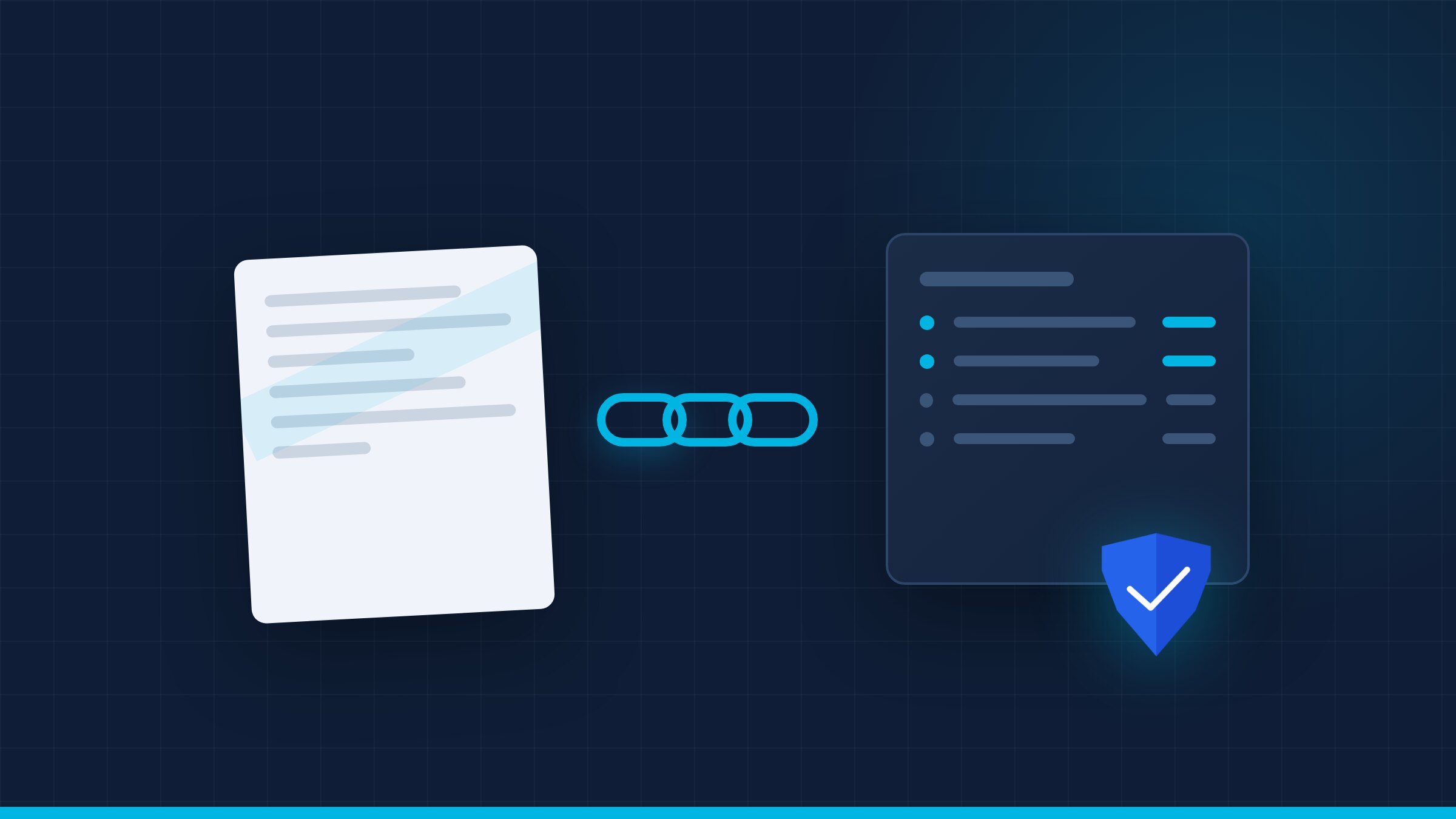
A chain of custody is a story that has to survive being questioned. In digital form it has two halves — integrity (the record did not change) and attribution (a specific person saw exactly this content) — and most systems only prove the first.
What chain of custody means for a digital document
The paper version was straightforward: a sealed envelope, a signed log, numbered pages, and a handoff recorded at every step. The point was never the paper itself — it was preserving a single, continuous path from the moment a record was created to the moment someone relied on it. In government chain of custody work, that path is the difference between a record and a rumour.
Digital breaks that path in a predictable way. A file can be copied without a trace, and a hash can prove the copy is identical without proving who looked at it. A hash is a fingerprint, not a witness.
Public records make the gap visible. In an audit of a procurement file, the question is rarely whether the PDF was altered. It is who consulted the evaluation report before the award, who downloaded the annex, and whether the version shown in the hearing is the version that was signed.
- Integrity is half the story — proving the record did not change says nothing about who read it.
- Session evidence — identity, time, document, and rendered content bound together.
- Retention is part of custody — a record you cannot produce later is a record you cannot defend.
Integrity: proving the file did not change
The technical foundation is well understood: cryptographic hashes, immutable storage, and version history. Together they answer the first question an auditor asks — is this the same record we had before?
The harder part is the log. It has to be tamper-evident, append-only, and rich enough to be useful: who acted, on which document, when, from which device or location, and with which policy decision. A spreadsheet that a system administrator can edit is not evidence.
External notarization or a trusted timestamp is not always necessary. For many administrative processes, a signed, exportable audit log stored under the same retention policy as the record is sufficient — provided the process around it is consistent and documented.
Attribution: proving who saw what
Attribution starts with the rendered page. A forensic watermark bound to the viewer and session means that any screenshot, printout, or photograph carries the identity of the session that produced it. The record of the session and the mark on the page are two views of the same event.
Identity is the second half. Shared accounts, generic administrator logins, and borrowed credentials destroy attribution no matter how good the watermark is. Named accounts, multi-factor authentication, and an identity provider that logs sign-ins are part of the chain, not outside it.
- Named viewers — one identity per action, with no shared service accounts in the evidence path.
- Session watermarks — the mark travels with the content, even when the content leaves the system as a photograph.
- Policy context — the rule that allowed the view, stored with the view itself.
- Exportable records — a format a reviewer can filter, sort, and attach to a case file.
Evidence for inspectors, auditors, and courts
An inspector usually asks three questions in sequence: show me the record, show me who could access it, and show me what actually happened. A document platform can answer all three only if authentication, access, rendering, and audit are designed as one pipeline.
Presentation matters. A dashboard screenshot is not evidence. What an auditor or a court can rely on is a stable export with timestamps, identities, document identifiers, and hash or watermark references — plus a written procedure describing how those records are generated and preserved. The NIST guide to integrating forensic techniques into incident response is a useful reference for what completeness looks like.
Admissibility rules vary by jurisdiction, and no vendor should promise a legal outcome. What a platform can do is make the technical story consistent enough that counsel can argue it. That is the standard worth designing for.
- One chain, not two systems — identity, access, and rendering linked in a single record.
- Tamper-evident exports — signed or hash-anchored, with a documented generation procedure.
- Retention aligned — the log kept as long as the record it describes, or longer.
- Rehearsed retrieval — produce the evidence for a real case before a dispute forces you to.
A practical model: capture, protect, prove
Three steps cover most public-sector needs. Capture the events that matter at the point they happen. Protect the record by keeping originals under your control and rendering only what the user needs. Prove it with an export that a third party can read without your help. Start with one process and test the export before the dispute, not after.
- Decide what to log — access, rendering, policy decisions, downloads, revocations, and administrative changes.
- Keep originals server-side — no cleartext copy at the endpoint, so there is less to lose and less to explain.
- Watermark every view — attribution at the page level remains useful even when logs are incomplete.
- Rehearse the export — hand the evidence to someone who did not build the system and see if they can follow it.
Custody is not a feature you switch on; it is a habit of capturing the right things at the right time and keeping them readable years later. When a record is questioned, the institution that can produce a clean, consistent story is the one that gets to move on. If your team handles records that end up in audits, hearings, or oversight reports, request a demo and we will rebuild the chain for one real document. For the legal side of the same problem, see document security for law firms; for the public-sector overview, start with document security for government. For the sovereignty layer, see data sovereignty for government documents.