Overview
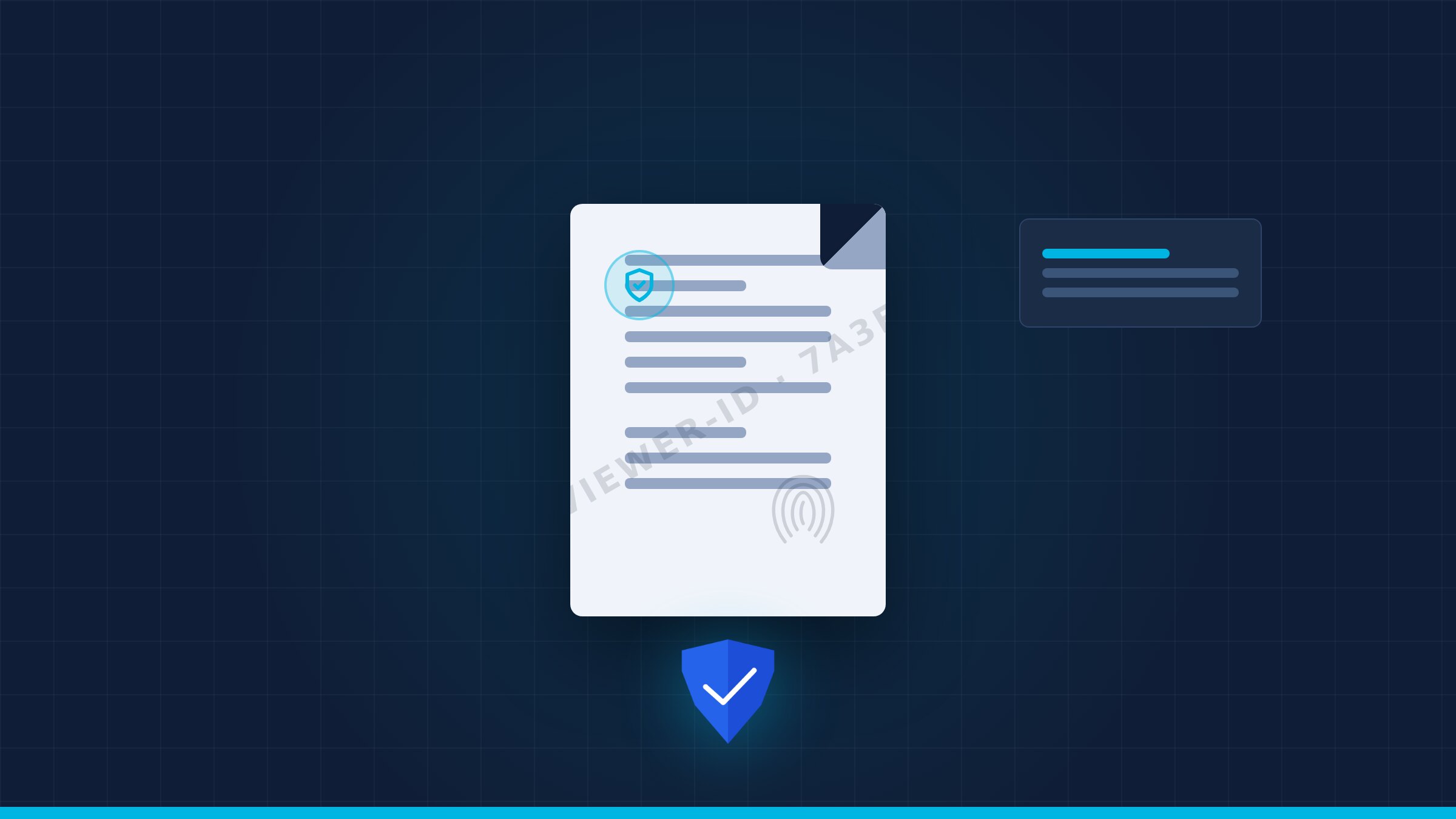
Forensic watermarking embeds invisible or visible identifiers into a document at the moment it is viewed, tying every pixel to a specific user, session, or device. It does not try to stop someone from taking a screenshot; it makes every leak traceable. That shift — from prevention to accountability — is why it often beats traditional DRM in real-world document workflows.
What forensic watermarking actually is
A forensic watermark is a mark you add to content after it has been authorized but before it reaches the eyeball. It can be visible — a faint name, email, or timestamp across the page — or invisible, encoded into the image in ways that survive resizing, compression, or even a photo of the screen. The key is that the mark is unique to that viewing session, so if a copy surfaces later, you can identify who leaked it.
In a secure document viewer, this happens at render time. The server rasterizes the page, burns the watermark into the pixels, and sends only the watermarked image to the browser. The original file never leaves the server, and the watermark travels with every frame. This is fundamentally different from header/footer stamps added to a PDF, which can be cropped or removed once the file is downloaded.
- Visible watermarks discourage casual sharing by naming the viewer directly on the page.
- Invisible watermarks survive screenshots, photos, and re-encoding.
- Session-specific metadata — user ID, timestamp, IP — makes every copy attributable.
Why traditional DRM is a dead end for documents
Traditional DRM was built for media: songs, movies, ebooks. Its goal is to encrypt the file and bind it to a license so the buyer cannot freely redistribute it. That model works reasonably well when the publisher controls the player — your music app, your streaming service — but it falls apart for enterprise documents.
A PDF is not a song. It needs to be read, printed, annotated, forwarded, and archived. DRM tries to block those actions with plugins and passwords, but the file itself still reaches the endpoint. Once it is there, a motivated user can defeat most protections. As NIST SP 800-207 on Zero Trust puts it, security should assume the network is already hostile; DRM assumes the endpoint can be trusted, and that assumption is the flaw.
- DRM protects the file; forensic watermarking protects the relationship between the file and the viewer.
- DRM is brittle — one broken plugin or shared password defeats the control.
- Watermarking keeps working even after the content leaves your control.
How it fits into a Zero Trust document strategy
Zero Trust for documents means never assuming a file is safe just because it is inside your network. Every access is verified, every session is scoped, and every view is logged. Forensic watermarking is the attribution layer of that model. It answers the question: if this document appears somewhere it should not, who was the last authorized person to see it?
This aligns with the Zero Trust principle of continuous verification: trust expires, and every request is a fresh decision. When combined with server-side rasterization — the topic of our server-side PDF rasterization guide — the result is a document workflow where the original never leaves your infrastructure and every view is stamped with identity.
- Verify identity on every page request, not just at login.
- Bind the watermark to the authenticated session, not just the user account.
- Store audit logs outside the viewer's reach so the evidence cannot be tampered with.
- Pair watermarking with least-privilege policies so users only see what they need.
Where forensic watermarking earns its keep
Some workflows are naturally leak-prone: due diligence, litigation holds, board packs, engineering reviews, and any situation where external parties need to read sensitive material. In these cases, preventing every possible copy is impossible. What you can do is raise the cost of leaking — make it clear that every page is tied to a person.
The OWASP File Upload Cheat Sheet reminds us to treat document formats as potentially hostile payloads. Rasterizing and watermarking before delivery does exactly that: it neutralizes the file's hidden structure and makes the visible surface accountable. That is why Aegis Secure View applies forensic watermarking to every rendered page by default.
- M&A and due diligence data rooms where leaks have legal consequences.
- Litigation and regulatory disclosure to external counsel.
- Engineering and CAD reviews shared with contractors and subcontractors.
- Board and executive reports distributed to a small, high-risk audience.
The bigger picture: watermarking plus zero-cleartext viewing
Watermarking alone is useful; watermarking combined with zero-cleartext viewing is a different class of control. When the server renders each page to pixels and stamps them with the viewer's identity, the endpoint receives a picture, not a file. There is nothing to save, forward, or sync. A screenshot is still possible, but it carries the leaker's name with it.
This is the architecture we describe in our guides on EDRM, Zero Trust for documents, and protecting documents from insider threats. Each layer reinforces the others: policy decides who can see what, rasterization prevents the original from traveling, and watermarking makes misuse attributable. If you are evaluating document security, ask not just whether files can be encrypted, but whether every view can be traced back to a person.
Forensic watermarking changes the conversation from 'can we stop every copy?' to 'can we identify the source of any copy?' In practice, the second question is both more answerable and more useful. If your organization shares sensitive documents with people you cannot fully control — and most do — watermarking is not an optional extra. It is the accountability layer that makes every other control credible. Want to see it in action on your own files? Request a demo and we will show you a live session where every page carries the viewer's identity.