Overview
Zero Trust for documents means never assuming a file is safe just because it sits inside your network. Every access request is verified — who, from where, on which device, with what permissions — before a single pixel is rendered. It treats every document view as a potential breach and acts accordingly.
The castle model is dead; the document is the new perimeter
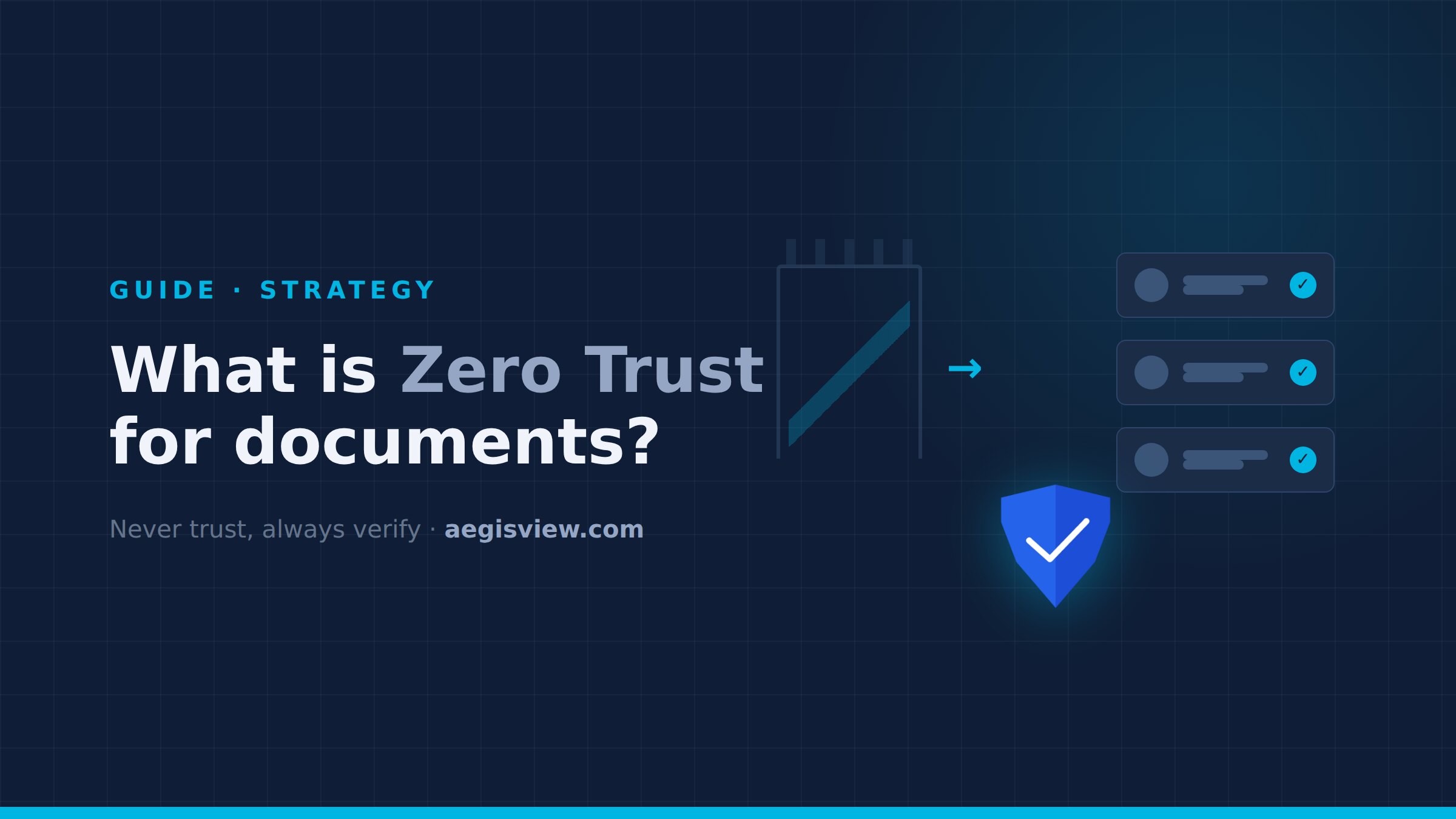
For decades we defended the network like a medieval castle: thick walls, a moat, and everyone inside trusted by default. That model made sense when employees sat at desks wired to corporate switches and files lived on file servers. But today a document can live in a cloud bucket, a synced folder, a contractor's laptop, or a phone in a coffee shop. The perimeter has dissolved — and yet many organizations still act as if being 'inside' means being safe.
Zero Trust flips the assumption. Instead of 'trust but verify,' it says 'never trust, always verify.' The question is no longer 'Is this user on our network?' but 'Should this specific user see this specific document, right now, from this specific context?' That shift is exactly what NIST SP 800-207 formalizes for enterprise architecture — and it applies with special force to documents.
- Verify identity, not location. A document request is judged by the user and their session, not by whether they are in the office.
- Verify the device. Managed, patched, and compliant endpoints get different treatment than unknown hardware.
- Verify continuously. Trust expires. Every new page view, search, or download is a fresh decision.
Why documents are the hardest Zero Trust problem
Most Zero Trust conversations focus on networks and applications. Documents are trickier because they are portable. A database stays in the data center; a PDF can be emailed, screenshotted, printed, or copied to a USB drive in seconds. Once the file leaves your control, all the network rules in the world stop mattering. This is why document security needs its own layer — the layer EDRM provides.
The strongest form of document-level Zero Trust is zero-cleartext viewing: the original file never reaches the client. The server renders each page in memory, applies a forensic watermark tied to the viewer, and streams only pixels. If you want to see what that looks like in practice, our secure viewer works exactly this way. The document is not shared; it is viewed under strict, revocable conditions.
From architecture to policy: how Aegis applies Zero Trust
Architectural decisions matter, but policy is where Zero Trust becomes enforceable. Aegis Shield turns access into explicit, deterministic rules: default-deny, explicit grants, and per-user or per-group exceptions. No hidden entitlements, no inherited permissions that nobody remembers. Every decision is logged for audit. This is the difference between saying you do Zero Trust and proving it to an auditor.
- Default-deny: if a policy does not explicitly allow the action, it is denied.
- Granular scope: rules apply to folders, documents, or actions like view, download, or upload.
- MFA as policy condition: sensitive documents can require a second factor for every session.
- Forensic audit: every view, search, and admin change is recorded with IP, geolocation, and session context.
Deployment matters too. You can run Aegis inside your own data center — even on-premise or air-gapped — so the verification logic and the documents stay under your custody. The cloud can be part of a Zero Trust strategy, but for your most sensitive files, keeping the enforcement point on infrastructure you control is not paranoia; it is sober risk management.
How to get started
- Inventory where sensitive documents actually live — cloud, local drives, email, shared folders, contractor systems.
- Map who has access today and whether that access is explicit or inherited.
- Identify your highest-risk files: customer data, IP, legal documents, financial records.
- Choose a viewing platform that verifies every access and never delivers the original file to the client.
Zero Trust is not a product; it is a discipline. But without the right tools, discipline becomes wishful thinking. If your sensitive documents still travel to endpoints as original files, you do not have Zero Trust for documents — you have a network firewall and a prayer. The good news is that moving to real document-level Zero Trust is easier than it sounds: verify every access, never transmit the original, and audit everything. That is the foundation Aegis Secure View is built on. If you want to see it in your own environment, request a demo.