Overview
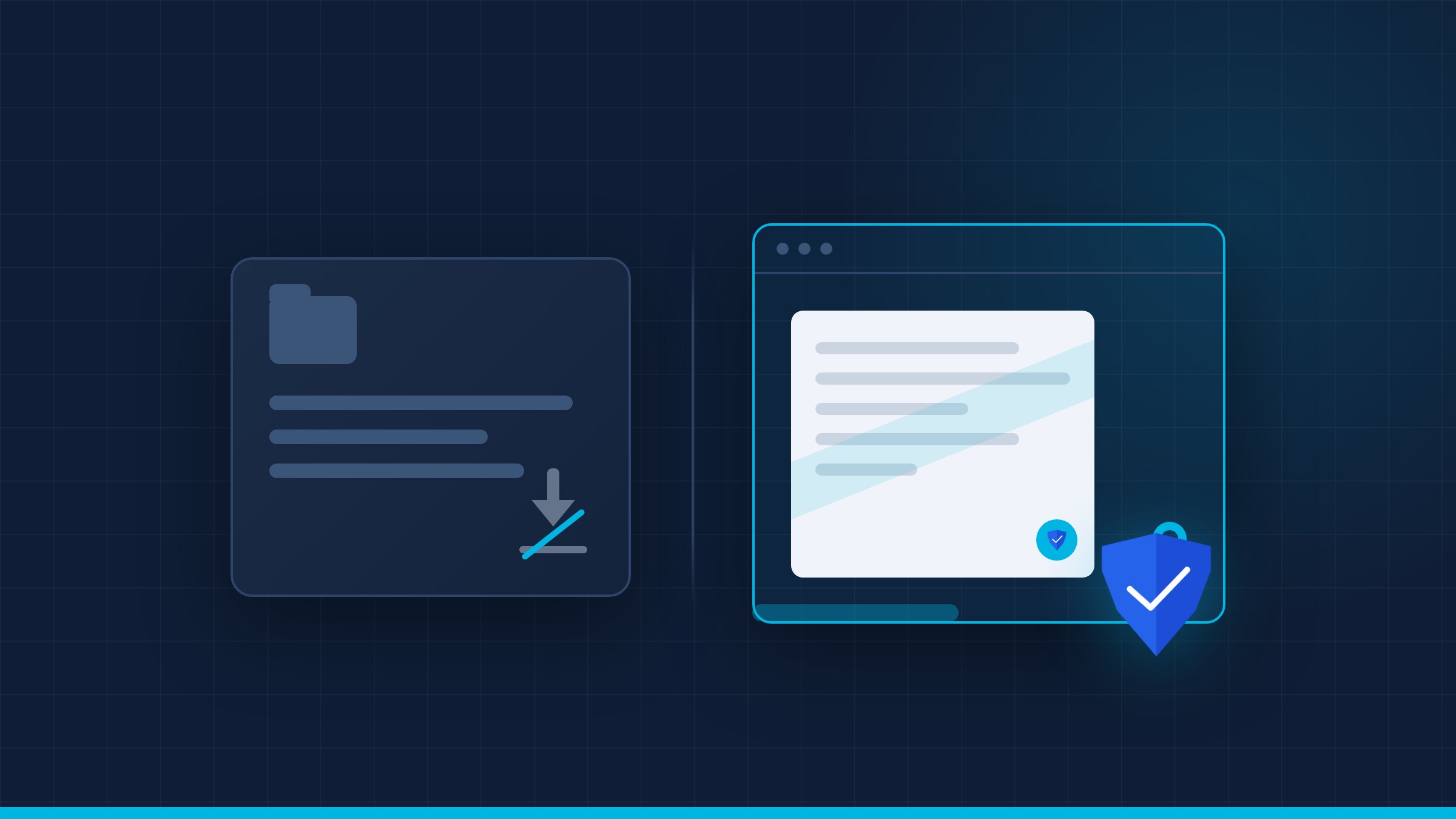
A virtual data room controls who can log in; an EDRM viewer controls what can leave. Both can host a due diligence process, but only one of them is built around the possibility that a bidder will try to keep a copy. The right choice depends on how much a leaked document would cost you.
The two models in one sentence
A traditional VDR is a hosted repository with access control bolted on: folders, permissions, Q&A, activity logs. Its job is to make deal documents available and to record who logged in. Traditional file sharing — a shared drive, Drive, Dropbox, email — puts the file on the endpoint and calls it collaboration. In practice, a virtual data room is the room; an M&A data room is the workflow that decides who sees which page.
An EDRM viewer is a delivery model for documents you cannot hand over: the original stays on your infrastructure, pages are rendered server-side, and every view is watermarked and logged. Its job is to make reading possible without transferring possession.
Most comparisons miss the distinction because both products look similar in a demo: a login, a folder tree, a PDF in the browser. The difference appears in what arrives at the bidder's laptop.
- VDR: controls access to the room.
- EDRM viewer: controls access to the document, every time it is rendered.
- The gap — traditional file sharing syncs a copy; the endpoint owns it.
Where traditional VDRs stop
Classic VDRs were designed when secure meant not public: encrypted storage, granular permissions, watermarked PDFs, NDAs. For many deals that is still enough, and pretending otherwise would be dishonest. The room records who entered; the copy, once downloaded, keeps no such record.
The failure mode is well known. A bidder with legitimate access downloads the file, and from then on the seller's controls are irrelevant. DRM plug-ins help until someone prints, photographs the screen, or opens the file on a different device.
VDRs have added dynamic watermarks and download restrictions over time, but the delivery model usually remains a file transfer somewhere in the chain. A watermark on a downloaded file is only useful after the leak has already happened.
What an EDRM viewer changes
The document never becomes a file on the endpoint. Each page is rendered to pixels, stamped with the viewer and session, and streamed. If access is revoked, the next page fails.
That changes the economics of a leak: the bidder can still photograph a screen, but the resulting image carries the session watermark — the mechanism behind forensic watermarking. NIST SP 800-207 frames the same idea as never trusting the endpoint; here it is applied to a single PDF.
- No download by default — the original stays server-side, rendered page by page.
- Per-session watermarks — a leaked photo points to a person and a moment.
- Live revocation — access removed while the review is still running.
- Server-side custody — the pipeline behind server-side PDF rasterization.
How to choose for your next deal
Start with the document class: teasers and marketing materials can live in a standard VDR; cap tables, customer contracts, source code, and litigation files deserve a model where the original cannot leave.
Then look at the process: how many bidders, how long the review lasts, whether anyone needs to print, and what evidence you would need after a leak. If the answer includes proving who saw which page, a plain VDR cannot get you there.
Cost and speed matter too. A traditional VDR is faster to stand up and familiar to deal teams. A hybrid approach is common and often sensible: VDR for the outer layers, EDRM viewer for the crown jewels. The point of comparing is not to pick a religion; it is to match the model to the file that would hurt most if it escaped.
- Document sensitivity first — classify by what happens if this file ends up in the wrong inbox.
- Audience and timeline — more bidders and longer reviews increase the surface.
- Evidence requirements — decide now what you would need to show after a leak.
- Deployment — cloud, on-premise, or air-gapped.
The buyer's checklist
When you evaluate either model, ask the same questions and compare the answers. They are the ones that matter after the deal closes, when nobody remembers the demo. A due diligence data room is judged by what it can prove after the deal, not by its folder tree.
- Can a user download the original file? If yes, under which permission and for how long?
- Does the watermark identify the person and the session, or only the account?
- Can access be revoked while the review is in progress?
- Where do the documents live, and what happens if the vendor is breached?
A VDR and an EDRM viewer are not competitors so much as different answers to the same question: how much control do you need over the copy? If the honest answer is that the document cannot leave, the room around it matters less than the delivery model. Request a demo and we will run the same deal document through both models so you can see where each one stops. For the deal-room checklist itself, read M&A data rooms and virtual data rooms.